Messy Millie
Conceived by: Megan Doyle & Jeffrey Sanzel
Direction & Choreography: Megan Doyle
Music & Lyrics: Andrew Heidorn
Book: Jeffrey Sanzel
Production History Fall 2022*, Spring 2024, Spring 2025, Spring 2026
*New York Times Weekend Pick
An original musical about difference, belonging, and discovering the tools to move through the world without losing what makes you extraordinary.
Millie Hammond has always been told that she is too messy, too loud, too distracted, and simply too much. When a magical guide offers to show her what the world would be like without her particular kind of chaos, Millie begins to see that the qualities others find challenging are also connected to her creativity, energy, and imagination.
Along the way, Millie learns practical tools for planning, listening, managing time, and working with others- not so that she can become a different person, but so that she can participate more fully while remaining herself.
About the Production
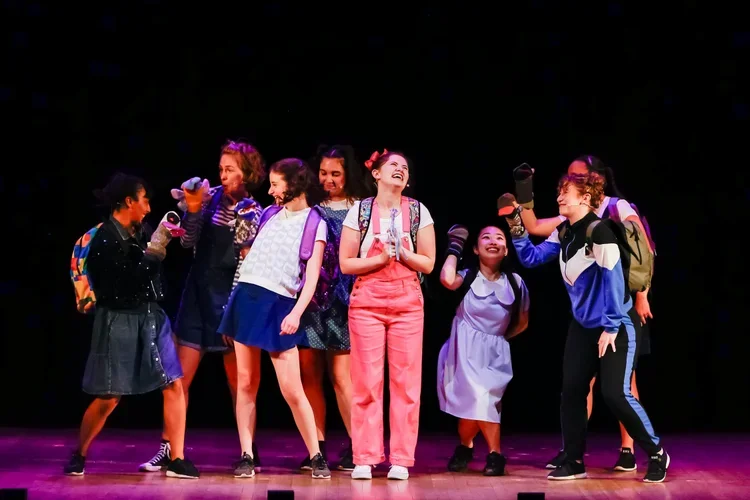
Messy Millie is an original musical created for young audiences and their adults. Developed and produced through 92NY Theater for Young Audiences, the production has been performed for family audiences and brought into New York City public schools through the Discover Musical Theater residency program.
The musical was created with neurodivergent children in mind, while remaining open to any young person who has ever felt misunderstood, overwhelmed, disorganized, or “too much.” It also speaks to the classmates, siblings, teachers, and friends learning how to understand and collaborate with someone whose mind works differently from their own.
Rather than naming a diagnosis, the production allows children to recognize themselves, or someone they know, within Millie’s experience.
Movement as Storytelling
Movement and choreography are central to the way Messy Millie tells its story. Millie’s internal experience becomes visible through rhythm, repetition, spatial relationships, and an ensemble world that sometimes moves at a different pace than she does.
The production invites young audiences to understand Millie not only through what she says, but through how she experiences time, space, expectations, and relationships. Choreography is not an addition to the story; it is one of the primary ways the audience learns to see the world from Millie’s perspective.
The Heart of the Work
Messy Millie does not ask Millie to become less creative, less energetic, or less herself. It asks a more complicated question: What tools might help a child navigate shared spaces while still honoring the qualities that make them who they are?
The production approaches accessibility as an artistic value rather than a simplification of the work. It trusts children with complexity, humor, emotional honesty, and the opportunity to form their own interpretations.
At its heart, Messy Millie is a celebration of the idea that every child can grow, learn, and contribute…and that each of us is magnificent in our own way.


